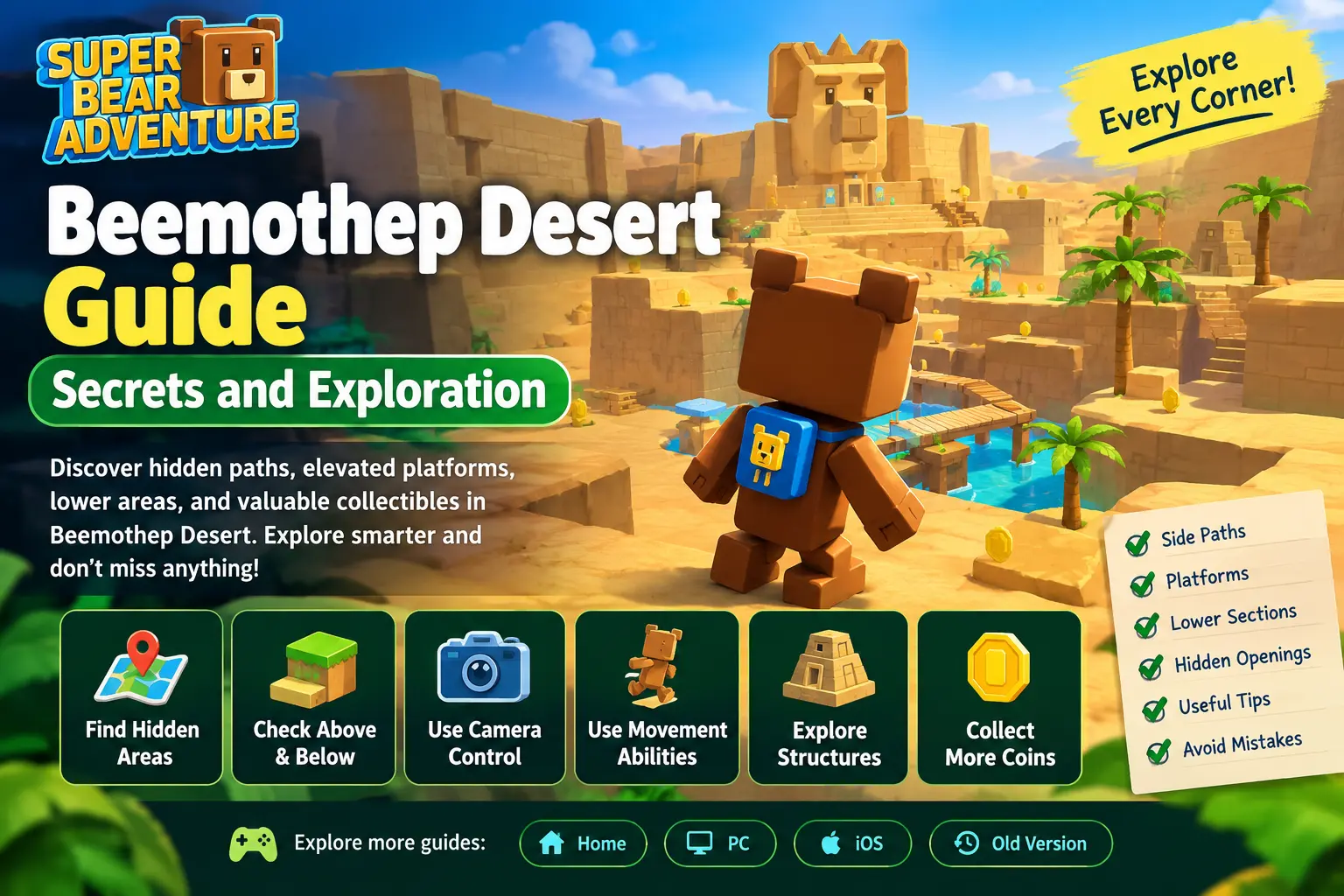
Super Bear Adventure Beemothep Desert Guide: Secrets and Exploration
Beemothep Desert is an open area in Super Bear Adventure where careful exploration can reveal alternative routes, elevated sections, lower paths, collectibles, and locations that are easy to overlook. Instead of following the most obvious route from start to finish, take time to check the surrounding environment and different levels of the area.
This Super Bear Adventure Beemothep Desert guide explains how to explore the area systematically, find less obvious routes, use movement and camera controls effectively, and avoid common mistakes that can cause you to miss parts of the environment.
How to Explore Beemothep Desert
A good way to explore Beemothep Desert is to learn the main route first and then inspect the sections around it.
Start by following the obvious path without trying to investigate every corner. This gives you a basic understanding of the area’s layout. Afterward, return to the sections that looked interesting and search them more carefully.
Focus on:
- Side paths away from the main route
- Raised platforms and ledges
- Lower sections beneath elevated paths
- Corners around large structures
- Narrow gaps and openings
- Areas close to the outer edges
- Routes partly hidden from the normal camera view
Exploring in sections makes it easier to remember where you have already been and reduces unnecessary backtracking.
Beemothep Desert Secrets and Hidden Areas
Some parts of Beemothep Desert can be difficult to notice because the environment can block your view of nearby routes. A location that looks like a dead end may become interesting when you approach it from another direction.
When exploring, watch for:
- Platforms that appear reachable from another position
- Gaps between structures
- Paths that disappear behind objects
- Lower areas hidden from the main route
- Unusual corners away from the obvious path
- Openings that are difficult to see while moving forward
If something looks different from the surrounding environment, stop and inspect it before moving on.
It is also worth approaching suspicious areas from more than one direction. A platform that seems unreachable from the front may have a more convenient approach from the side or from a nearby elevated position.
Check Above and Below the Main Route
One of the easiest ways to overlook parts of an open area is to search only at ground level.
While moving through Beemothep Desert, regularly check different heights. Look above the main route for platforms and ledges, then inspect underneath bridges, raised paths, and elevated sections.
Look for Raised Platforms
When you spot a higher platform, do not immediately attempt the jump from your current position.
First, look around for a better starting point. A nearby ledge or alternate route may give you a more suitable angle and make the movement easier.
If you need a refresher on movement and positioning, see the Super Bear Adventure Controls and Movement Guide.
Check Lower Sections
Lower areas are easy to miss when your character is traveling along an elevated route.
Whenever you cross a bridge, raised platform, or similar section, briefly look underneath and around it. A lower path may be hidden outside your normal forward-facing view.
Search Around Desert Structures
Large structures can block your view and make nearby areas appear to be dead ends.
When you reach a noticeable structure, do not check only the front. Move around it and inspect the sides, back, corners, and nearby open spaces.
Look for:
- Corners behind structures
- Spaces beside large objects
- Small ledges
- Narrow passages
- Openings near the route
- Areas that become visible from the side
Camera movement is especially useful here. Something hidden behind an object may become visible as soon as you change your position or viewpoint.
Use Movement Abilities Carefully
Movement abilities can help you reach sections that are not directly connected to the main route.
If a location appears slightly out of reach, first determine what is preventing access. It may be the distance, height, angle, or your current position.
A better approach is to:
- Identify the section you want to reach.
- Inspect nearby platforms and surfaces.
- Check the height and distance.
- Find a better starting position.
- Use the appropriate movement ability.
- If the route still seems inaccessible, explore the surrounding area before trying again.
This avoids wasting time repeating the same movement from an unsuitable position.
Use the Camera to Reveal Hidden Routes
Camera control is particularly useful when exploring open sections of Beemothep Desert.
When entering a new area, briefly look around instead of keeping the camera fixed in the direction of travel. This can reveal platforms, openings, lower paths, or spaces behind structures.
Check:
- Behind your character
- Above the current route
- Below elevated sections
- Around large structures
- Toward the outer edges
- Behind objects that block your view
A different viewpoint can sometimes make an otherwise confusing section much easier to understand.
Explore Areas That Look Empty
An open or empty-looking section does not necessarily mean there is nothing worth checking.
Instead of immediately ignoring it, look for unusual gaps, corners, platforms, or routes that connect to another part of the area. Some locations are easier to understand once you approach them from a different direction.
This is especially useful when your goal is thorough exploration rather than simply reaching the next objective.
A Simple Beemothep Desert Exploration Route
If you want to explore Beemothep Desert without repeatedly covering the same ground, use this order.
Step 1: Learn the Main Route
Follow the obvious path first and pay attention to the overall layout.
The goal is not to inspect every corner immediately. First understand where the main route leads and which sections connect to it.
Players using Apple devices can also check our Super Bear Adventure for iOS guide for more information.
Step 2: Search Both Sides
Return through the area and inspect both sides of the route.
Check for alternate paths, platforms, openings, structures, and lower sections that were easy to miss while moving forward.
Step 3: Check Higher Areas
Look for raised platforms and ledges.
If a platform appears reachable, find a suitable starting position instead of repeatedly attempting the same jump.
Step 4: Check Lower Areas
Inspect underneath bridges, elevated routes, and platforms.
Pay particular attention to areas that disappear from view when you are following the main route.
Step 5: Inspect Structures
Walk around large objects and structures.
Check their sides, corners, back areas, and nearby openings before deciding that the section has nothing else to explore.
Step 6: Revisit Unclear Locations
If you find a location that looks interesting but cannot immediately understand how to reach it, remember where it is and continue exploring nearby sections.
Return later once you have a better understanding of the surrounding layout.
This approach keeps exploration organized and helps reduce unnecessary backtracking.
Beemothep Desert Exploration Tips
Keep these practical tips in mind:
- Slow down in large sections. Moving too quickly makes small openings and unusual routes easier to overlook.
- Change the camera regularly. A different viewpoint can reveal areas hidden behind objects.
- Search multiple heights. Check ground-level routes, elevated platforms, and lower sections.
- Explore both sides of the route. The obvious path is not always the only useful route.
- Walk around structures. The side or back of a structure may reveal an opening hidden from the front.
- Use better positioning. Moving to a suitable starting point can make difficult movement easier.
- Revisit unusual locations. A second look can make a confusing route easier to understand.
- Avoid repeated trial and error. If a route does not work, inspect the environment before trying the same move again.
Common Beemothep Desert Exploration Mistakes
Following Only the Main Path
The main route is useful for understanding the area, but following it without checking nearby sections can cause you to overlook alternate routes and less obvious spaces.
Ignoring Vertical Areas
Searching only at ground level makes raised platforms and lower routes much easier to miss.
Always consider what may be above or below your current position.
Keeping the Camera in One Position
A fixed viewpoint limits what you can see.
Rotate the camera when entering open sections, approaching structures, or checking an area that appears to be a dead end.
Repeating the Same Jump
If a jump does not work, do not immediately repeat it several times.
Check your position and look for another route or starting point that may provide a better approach.
Leaving an Area Too Quickly
Before moving to another section, take a few seconds to inspect the surrounding environment.
This small habit can save time later because you will not need to return simply to check an area you skipped.
Beemothep Desert Exploration Checklist
Before considering a section thoroughly explored, check whether you have:
- Followed the main route
- Checked both sides of the path
- Looked for raised platforms
- Checked lower sections
- Inspected structures and corners
- Changed the camera angle
- Investigated unusual gaps and openings
- Looked behind large objects
- Checked areas near the outer edges
- Revisited difficult or suspicious locations
- Considered whether a different movement approach is needed
Using this checklist gives you a simple way to explore the area systematically without repeatedly searching the same sections.
If you are looking for an earlier release, visit our Super Bear Adventure Old Version page to learn more about previous versions.
Frequently Asked Questions
What should I look for in Beemothep Desert?
Look for side paths, raised platforms, lower sections, corners, structures, unusual openings, and areas that are difficult to see from the main route. Changing the camera angle can also reveal overlooked locations.
Is it worth exploring both sides of the main path?
Yes. Searching both sides can help you notice platforms, lower sections, alternate routes, and areas that are not visible while following the main path.
How can I reach higher areas in Beemothep Desert?
Start by checking the surrounding platforms and finding a suitable position. Then use the movement technique that fits the route. If the jump repeatedly fails, look for another approach instead of continuing from the same position.
Why is camera control important in Beemothep Desert?
The camera helps you inspect areas behind structures, above platforms, below elevated routes, and around corners. Changing the viewpoint can reveal locations that are hidden from your normal direction of travel.
What is the best way to explore Beemothep Desert?
Start by learning the main route, then explore the surrounding sections one at a time. Check different heights, inspect structures, change camera angles, and revisit locations that look difficult or unusual.
How can I avoid missing areas in Beemothep Desert?
Explore at a steady pace and check more than just the main route. Look above and below elevated sections, inspect both sides of the path, move around structures, and use the camera to check areas hidden from view.
Final Thoughts
If you prefer playing on a larger screen, check our Super Bear Adventure for PC guide for setup and gameplay tips.
Exploring Beemothep Desert is easier when you treat the area as more than a route between objectives. Take time to understand the layout, inspect different heights, move around structures, and use the camera to reveal sections that are difficult to see from the normal viewpoint.
The most effective approach is to learn the main route first and then explore the surrounding areas systematically. Check side paths, platforms, lower sections, corners, and unusual openings before moving on.
For more exploration techniques across the game, see the Super Bear Adventure Exploration Guide. If you need help with movement and positioning while exploring, the Super Bear Adventure Controls and Movement Guide can also help.